There was a minor media flap the other day when former CIA official Paul Pillar went public (again) with accusations that the Bush Administration "cherry picked" intelligence to justify invading Iraq. Thomas Joscelyn and Stephen Hayes do an excellent job of de-constructing Mr. Pillar's charges, reminding us that Pillar has been a long-time critic of the White House, and was guilty of his own "cherry picking" in the past.
On a related note, the accusation of cherry picking is something of a red herring in the intel business, and Mr. Pillar knows it. Any major report, assessment, or National Intelligence Estimate (NIE) is cobbled from dozens, sometimes hundreds of bits of data, drawn from a variety of sources. Determining the material that is used (or ignored) in the final report is left up to the analyst and his supervisors. And, for better or worse, most analysts in 2002-2003 believed that Saddam had WMD. Mr. Pillar may call it cherry picking, but that assessment reflected the consensus of the intel community at that time, based on information extracted from literally thousands of reports.
As Hayes and Joscelyn point out, Pillar's performance as National Intelligence Officer on the Near East/South Asia desk left much to be desired. That performance, coupled with his outspoken criticism of the Bush Administration, apparently hastened his departure from Langley. So there's more than a element of sour grapes in Pillar's charges--something the WaPo left out (surprise, surprise) in its original report.
Saturday, February 11, 2006

Friday, February 10, 2006
An Incomplete Search?
Interesting article by Eli Lake in Thursday's New York Sun (Hat tip to Lorie Byrd of Polipundit). Mr. Lake has a piece in on Special Agent (SA) David Gaubatz, who served with the Air Force Office of Special Investigations (OSI) in Iraq, shortly after the fall of Saddam in 2003.
As an investigator, SA Gaubatz worked out of Talil Airbase, gathering information on the whereabouts of former regime members and WMD in the Nasiriyah area. Over the course of several months, Gaubatz claims that Iraqi informants led him four underground bunkers--three in Nasiriyah, one near the port of Umm Qasr. In each case, sources told him the underground facilities contained chemical or biological weapons, or missiles whose range exceeded those permitted under UN sanctions. Gaubatz reports that the tunnels to each of the facilities had been flooded, making it impossible to access them.
However, the Air Force investigator forwarded lengthy reports on each complex to the then-forming Iraqi Survey Group (ISG) , complete with accurate grid coordinates, photographs and information from multiple sources. But, according to Gaubatz, the ISG never bothered to follow up on three of the facilities. In once case where they did visit a suspected facility, they lacked the equipment needed to penetrate the bunker's thick concrete walls.
The two men who led the ISG (David Kay and Charles Duelfer) either refused comment, or failed to respond to Lake's request for an interview. The chairman of the House Intelligence Committee remains unconvinced that Saddam destroyed his entire WMD arsenal before the U.S. led invasion almost three years ago. The committee, as Eli Lake notes, recently reopened the question of what happened to Saddam's WMDs. It sounds like part of that inquiry should focus on how the ISG did--or failed to do--it's job.
One observation: most OSI agents specialize in criminal investigations, while others focus on counter-intelligence operations. Judging from the brief description of Gaubatz's resume, it sounds like he was a counter-intelligence specialist, skilled in gathering information from field sources, and fusing it together in finished reports. It would be interesting to note if any of Gaubatz's fellow agents (OSI teams typically operate as part of small detachments, both at home and in the field) had similar experiences in southern Iraq, and if their reports were ignored. Corroborating information from other investigators in the region would certainly add some credence to Gaubatz's claims. Here's hoping that Congressman Pete Hoekstra brings Gaubatz and his fellow agents before his intelligence committee, and subpoenas copies of those OSI field reports from 2003.
As an investigator, SA Gaubatz worked out of Talil Airbase, gathering information on the whereabouts of former regime members and WMD in the Nasiriyah area. Over the course of several months, Gaubatz claims that Iraqi informants led him four underground bunkers--three in Nasiriyah, one near the port of Umm Qasr. In each case, sources told him the underground facilities contained chemical or biological weapons, or missiles whose range exceeded those permitted under UN sanctions. Gaubatz reports that the tunnels to each of the facilities had been flooded, making it impossible to access them.
However, the Air Force investigator forwarded lengthy reports on each complex to the then-forming Iraqi Survey Group (ISG) , complete with accurate grid coordinates, photographs and information from multiple sources. But, according to Gaubatz, the ISG never bothered to follow up on three of the facilities. In once case where they did visit a suspected facility, they lacked the equipment needed to penetrate the bunker's thick concrete walls.
The two men who led the ISG (David Kay and Charles Duelfer) either refused comment, or failed to respond to Lake's request for an interview. The chairman of the House Intelligence Committee remains unconvinced that Saddam destroyed his entire WMD arsenal before the U.S. led invasion almost three years ago. The committee, as Eli Lake notes, recently reopened the question of what happened to Saddam's WMDs. It sounds like part of that inquiry should focus on how the ISG did--or failed to do--it's job.
One observation: most OSI agents specialize in criminal investigations, while others focus on counter-intelligence operations. Judging from the brief description of Gaubatz's resume, it sounds like he was a counter-intelligence specialist, skilled in gathering information from field sources, and fusing it together in finished reports. It would be interesting to note if any of Gaubatz's fellow agents (OSI teams typically operate as part of small detachments, both at home and in the field) had similar experiences in southern Iraq, and if their reports were ignored. Corroborating information from other investigators in the region would certainly add some credence to Gaubatz's claims. Here's hoping that Congressman Pete Hoekstra brings Gaubatz and his fellow agents before his intelligence committee, and subpoenas copies of those OSI field reports from 2003.
Mr. Libby's Leak
An interesting twist in the Scooter Libby case was revealed yesterday. According to court documents filed last month--and unearthed by the Associated Press--Special Prosecutor Patrick Fitzgerald plans to introduce evidence that Mr. Libby's superiors authorized him to give secret information to reporters. The leaks were apparently part of the administration's defense of intelligence used to justify the invasion of Iraq. Mr. Libby, as you'll recall, was the former Chief of Staff for Vice President Dick Cheney, so the "superiors" who okayed the leaks would (presumably) include the VP.
Fitzgerald's court filings indicate that Libby was authorized to leak portions of a National Intelligence Estimate (NIE) to reporters in the summer of 2003, as the administration defended intelligence used in deciding to go to war in Iraq. Occasionally, portions of NIEs are declassified and released to the public, although it's not clear if that happened in this case.
The special prosecutor's charge is designed to show a pattern of leaks by Mr. Libby, including Valerie Plame's supposed status as a covert CIA officer. The divulgence of Ms. Plame's "identity" launched Fitzgerald's investigation more than two years ago. So far, Libby has only been charged with lying to federal agents and a grand jury about how he learned of Ms. Plame's identity, and when he subsequently told reporters.
Of course, Libby has not been charged with violating the federal law that makes it a crime to willingly disclose the identity of an undercover intelligence operative. We've discussed that issue at great length in this blog. Suffice it to say, Mr. Fitzgerald didn't indict on that charge because his case would be shaky at best. There is compelling evidence that Ms. Plame had come "in from the cold" years earlier. There is also evidence that her former status as a undercover operative was permanently "blown" in the Aldrich Ames spy scandal, meaning that she could never work as a covert agent again.
However, it is also interesting that Libby has not been indicted on charges of willfully divulging classified iinformation, and that begs and obvious question--why? Mr. Fitzgerald apparently has evidence that Libby was authorized to discuss portions of a classified document with the media, but neither he (nor other White House officials) have been charged with that crime (at least not yet).
Why no indictment(s) on those charges? A couple of reasons. First of all, officials at the highest levels of the executive branch (read: The President and Vice-President) are understood to have "declassification authority" for any type of classified material. The development of the B-2 bomber, for example, was a closely-guarded, black world program back in the 1970s until President Carter decided to discuss it in a speech, as proof that he wasn't weak on national defense. In the matter of a few sentences, the B-2 moved from the black world into the white world, with an official budget "line," public relations hand-outs and all the other trappings of an "official" program. Why wasn't Carter investigated? As commander-in-chief, he had the authority to "declassify" the B-2 program in a public address.
Accordingly, every chief executive has had the authority to "move" information from the classified to the unclassified realm, through speeches, comments, and leaks. As we noted yesterday, every administration has played the leak game to some degree, and the Bush White House is no exception. I'm no fan of this approach--whether the leakers are Republicans or Democrats--because it makes the job of protecting our secrets that much more difficult. Most of us in the intel business (both current and former) have had the unpleasant experience of seeing information that was classified SECRET or TS/SCI suddenly splashed across the front page of the Washington Post or The New York Times. If Bush or Cheney authorized the declassification and dissemination of portions of the NIE, it was probably legal, even if there isn't an accompanying paper trail. So much for security.
But there's also another reason that Fitzgerald won't touch the apparent leak of the NIE. That intelligence estimate was widely circulated in both the executive branch and congress. There were, as I recall, a number of leaks of material from that NIE in the summer of 2003, and some of them probably originated on Capitol Hill. If Fitzgerald decided to go after the White House on this issue, Congressional Republicans would probably demand an investigation of NIE leaks on Capitol Hill, and there wouldn't be a shortage of potential suspects. By focusing only on Mr. Libby, the special counsel would open himself--and his investigation--to charges that his inquiry had become a partisan witch hunt, much like former counsel Lawrence Walsh's investigation into the Iran-Contra affair, culminating in the indictment of Cap Weinberger just before the 1992 presidential election.
So, Mr. Fitzgerald will ignore the issue of possible criminal behavior in NIE leak, and instead use it to buttress his perjury case against Mr. Libby. Senate Democrats--led by Ted Kennedy--are already demanding that VP Cheney also take responsibility for the leak, but that's an example of tossing the first stone in a glass house. Rumors in Washington suggest that two Democratic senators may be under investigation for leaking classified information, so Teddy's party is not without sin in this matter. He'd be well-advised to keep quite, at least until Senators Rockefeller and Dryden are cleared on charges they leaked classified information.
But the real essence of this matter is how our senior officials protect the nation's secrets. Paraphrasing F. Scott Fitzgerald [senior officials, both current and former] "are different from you and me." From classified documents on John Deutch's home computer, to Sandy "classified documents down my pants" Berger, senior officials and lawmakers are held to a lower standard than mere mortals with a security clearance. We have often cited the statistic of 600 leak investigations (by the FBI) since the mid-1990s, with zero prosecutions. Until we stop the leak game, hold everyone to the same standard, and send some of these people to jail, the leaks will only continue--and our national security will continue to suffer.
Fitzgerald's court filings indicate that Libby was authorized to leak portions of a National Intelligence Estimate (NIE) to reporters in the summer of 2003, as the administration defended intelligence used in deciding to go to war in Iraq. Occasionally, portions of NIEs are declassified and released to the public, although it's not clear if that happened in this case.
The special prosecutor's charge is designed to show a pattern of leaks by Mr. Libby, including Valerie Plame's supposed status as a covert CIA officer. The divulgence of Ms. Plame's "identity" launched Fitzgerald's investigation more than two years ago. So far, Libby has only been charged with lying to federal agents and a grand jury about how he learned of Ms. Plame's identity, and when he subsequently told reporters.
Of course, Libby has not been charged with violating the federal law that makes it a crime to willingly disclose the identity of an undercover intelligence operative. We've discussed that issue at great length in this blog. Suffice it to say, Mr. Fitzgerald didn't indict on that charge because his case would be shaky at best. There is compelling evidence that Ms. Plame had come "in from the cold" years earlier. There is also evidence that her former status as a undercover operative was permanently "blown" in the Aldrich Ames spy scandal, meaning that she could never work as a covert agent again.
However, it is also interesting that Libby has not been indicted on charges of willfully divulging classified iinformation, and that begs and obvious question--why? Mr. Fitzgerald apparently has evidence that Libby was authorized to discuss portions of a classified document with the media, but neither he (nor other White House officials) have been charged with that crime (at least not yet).
Why no indictment(s) on those charges? A couple of reasons. First of all, officials at the highest levels of the executive branch (read: The President and Vice-President) are understood to have "declassification authority" for any type of classified material. The development of the B-2 bomber, for example, was a closely-guarded, black world program back in the 1970s until President Carter decided to discuss it in a speech, as proof that he wasn't weak on national defense. In the matter of a few sentences, the B-2 moved from the black world into the white world, with an official budget "line," public relations hand-outs and all the other trappings of an "official" program. Why wasn't Carter investigated? As commander-in-chief, he had the authority to "declassify" the B-2 program in a public address.
Accordingly, every chief executive has had the authority to "move" information from the classified to the unclassified realm, through speeches, comments, and leaks. As we noted yesterday, every administration has played the leak game to some degree, and the Bush White House is no exception. I'm no fan of this approach--whether the leakers are Republicans or Democrats--because it makes the job of protecting our secrets that much more difficult. Most of us in the intel business (both current and former) have had the unpleasant experience of seeing information that was classified SECRET or TS/SCI suddenly splashed across the front page of the Washington Post or The New York Times. If Bush or Cheney authorized the declassification and dissemination of portions of the NIE, it was probably legal, even if there isn't an accompanying paper trail. So much for security.
But there's also another reason that Fitzgerald won't touch the apparent leak of the NIE. That intelligence estimate was widely circulated in both the executive branch and congress. There were, as I recall, a number of leaks of material from that NIE in the summer of 2003, and some of them probably originated on Capitol Hill. If Fitzgerald decided to go after the White House on this issue, Congressional Republicans would probably demand an investigation of NIE leaks on Capitol Hill, and there wouldn't be a shortage of potential suspects. By focusing only on Mr. Libby, the special counsel would open himself--and his investigation--to charges that his inquiry had become a partisan witch hunt, much like former counsel Lawrence Walsh's investigation into the Iran-Contra affair, culminating in the indictment of Cap Weinberger just before the 1992 presidential election.
So, Mr. Fitzgerald will ignore the issue of possible criminal behavior in NIE leak, and instead use it to buttress his perjury case against Mr. Libby. Senate Democrats--led by Ted Kennedy--are already demanding that VP Cheney also take responsibility for the leak, but that's an example of tossing the first stone in a glass house. Rumors in Washington suggest that two Democratic senators may be under investigation for leaking classified information, so Teddy's party is not without sin in this matter. He'd be well-advised to keep quite, at least until Senators Rockefeller and Dryden are cleared on charges they leaked classified information.
But the real essence of this matter is how our senior officials protect the nation's secrets. Paraphrasing F. Scott Fitzgerald [senior officials, both current and former] "are different from you and me." From classified documents on John Deutch's home computer, to Sandy "classified documents down my pants" Berger, senior officials and lawmakers are held to a lower standard than mere mortals with a security clearance. We have often cited the statistic of 600 leak investigations (by the FBI) since the mid-1990s, with zero prosecutions. Until we stop the leak game, hold everyone to the same standard, and send some of these people to jail, the leaks will only continue--and our national security will continue to suffer.
Thursday, February 09, 2006
Recommended Reading
A hat tip to reader Steve M., for steering me to this Saudi blog, The Religious Policeman. Blogger Alhamedi is a superb writer and does a terrific job highlighting the hypocrisy of Islamic fanatics who have fanned the cartoon "crisis." Meanwhile, Steve raises a very good question: why haven't western governments--including our own--been more critical of the Saudi role in this controversy? Something about the free flow of oil at market prices, I suppose?
Isolationism by Another Name
A hat tip to Stephen Green at Vodkapundit for the kind words about my blog, and also for this item, posted by Rich Lowery at "The Corner" a couple of days ago.
According to Mr. Lowery, there's something of a debate emerging on what conservative foreign policy should be after George W. Bush. Rich detects an air of frustration among some conservatives over the War in Iraq, and the wisdom of trying to "democratize" other Middle Eastern countries. He refers to this "movement" (perhaps a premature description) as "to hell with them hawks." In other words, it was proper to invade Iraq and get rid of Saddam, but we should have withdrawn immediately, and left the country to its own devices. Ditto for any sort of military action against Iran.
As an example of this sort of thinking, Lowery cites Fred Barnes's recent comments on FNC. Noting escalating protests over the Danish cartoons in the Middle East, Fred decided that this is not a fringe protest, but a representation of "mainstream" Islam that will never fully embrace western values, culture or democracy. In other words, the battle for Islamic hearts and minds has already been lost, so "to hell with them."
Of course, such thinking is nothing new; it's simply the latest variation on the isolationism that conservatives have periodically embraced for more than a century. Unfortunately, as the world's only remaining superpower, we lost that option a long time ago. Besides, as Steve Green so accurately describes it, the "victory and retreat" strategy carries unacceptable risks, particularly in the Middle East.
"Of course, we might find that we had to re-invade Iraq in five years. Or let the Turks in, to "protect" the Kurds. Or that Iran would annex the oil-rich Shia regions. We might find that someday we'd have to invade Iran – with no friendly land bases nearby. Today, we have a violent and dysfunctional Iraq, but the "to hell with them" scenario just leaves a hole in the map to be filled in by al Qaeda and their ilk."
"There's another danger, too. What little cohesion exists among hawks today could easily fall apart. I don't care if the next President is a Republican or Democrat, so long as they're a hawk. Otherwise we would face another round of the Clinton Administration's do-nothing mentality. Back in the '90s, at least we could plead some kind of ignorance. Ten or twelve years ago, the Crazies attacked us far away, in Africa or Saudi Arabia or in foreign waters. Yet by failing to respond, we taught al Qaeda how to attack us here at home."
As the liberators of Iraq, we have a responsibility to defend the country from internal and external threats, and help the Iraqi people move toward a democratic system--just as we did in post-war Germany and Japan. There are limits to what we should do in Iraq--and how long we should remain--but the idea of knocking off Saddam (or any other dictatorship) and then sailing home is simply a non-starter.
A better idea is to encourage democratic movements in countries like Iran, and work hard for regime change. When the Solidarity movement began in Poland, it seemed inconceivable that a group of shipyard workers would eventually bring down Soviet communism and free Eastern Europe. Today, there are millions of Iranians who are tired of the mullahs and are looking for a new government, but they need support and encouragment from the west; President Bush said as much during his recent State of the Union address. Going isolationist (again) is not the way to win friends or produce regime change in Tehran, Gaza City, or Damascus. Similarly, we can't bring lasting change by mounting a military campaign, declaring victory, bringing our troops home, and simply hoping for the best.
According to Mr. Lowery, there's something of a debate emerging on what conservative foreign policy should be after George W. Bush. Rich detects an air of frustration among some conservatives over the War in Iraq, and the wisdom of trying to "democratize" other Middle Eastern countries. He refers to this "movement" (perhaps a premature description) as "to hell with them hawks." In other words, it was proper to invade Iraq and get rid of Saddam, but we should have withdrawn immediately, and left the country to its own devices. Ditto for any sort of military action against Iran.
As an example of this sort of thinking, Lowery cites Fred Barnes's recent comments on FNC. Noting escalating protests over the Danish cartoons in the Middle East, Fred decided that this is not a fringe protest, but a representation of "mainstream" Islam that will never fully embrace western values, culture or democracy. In other words, the battle for Islamic hearts and minds has already been lost, so "to hell with them."
Of course, such thinking is nothing new; it's simply the latest variation on the isolationism that conservatives have periodically embraced for more than a century. Unfortunately, as the world's only remaining superpower, we lost that option a long time ago. Besides, as Steve Green so accurately describes it, the "victory and retreat" strategy carries unacceptable risks, particularly in the Middle East.
"Of course, we might find that we had to re-invade Iraq in five years. Or let the Turks in, to "protect" the Kurds. Or that Iran would annex the oil-rich Shia regions. We might find that someday we'd have to invade Iran – with no friendly land bases nearby. Today, we have a violent and dysfunctional Iraq, but the "to hell with them" scenario just leaves a hole in the map to be filled in by al Qaeda and their ilk."
"There's another danger, too. What little cohesion exists among hawks today could easily fall apart. I don't care if the next President is a Republican or Democrat, so long as they're a hawk. Otherwise we would face another round of the Clinton Administration's do-nothing mentality. Back in the '90s, at least we could plead some kind of ignorance. Ten or twelve years ago, the Crazies attacked us far away, in Africa or Saudi Arabia or in foreign waters. Yet by failing to respond, we taught al Qaeda how to attack us here at home."
As the liberators of Iraq, we have a responsibility to defend the country from internal and external threats, and help the Iraqi people move toward a democratic system--just as we did in post-war Germany and Japan. There are limits to what we should do in Iraq--and how long we should remain--but the idea of knocking off Saddam (or any other dictatorship) and then sailing home is simply a non-starter.
A better idea is to encourage democratic movements in countries like Iran, and work hard for regime change. When the Solidarity movement began in Poland, it seemed inconceivable that a group of shipyard workers would eventually bring down Soviet communism and free Eastern Europe. Today, there are millions of Iranians who are tired of the mullahs and are looking for a new government, but they need support and encouragment from the west; President Bush said as much during his recent State of the Union address. Going isolationist (again) is not the way to win friends or produce regime change in Tehran, Gaza City, or Damascus. Similarly, we can't bring lasting change by mounting a military campaign, declaring victory, bringing our troops home, and simply hoping for the best.
The Devil's in the Details
After initially balking, the White House has relented, and provided additional details on the NSA domestic surveillance program to the Congress. For several weeks, members of the House and Senate have been pressing the administration for more information on program, but the White House rejected their requests, saying that Congress could not be trusted with highly classified national security information.
It's hard to resist the temptation to say that there's truth in that allegation. You may recall that Vermont's Patrick "Leaky" Leahy was actually forced to resign from the Senate intelligence committee in the 1980s for divulging classified information on several occasions. Former House Armed Services Committee Chairman Ron "Red" Dellums held a Top Secret clearance for years, despite his refusal to sign non-disclosure agreements that come with access to secret information. GOP.com has an excellent summary of past Democratic intelligence leaks and similar "failures." However, in fairness, I should point out that some Republicans have done the same thing, and every Administration plays the "leak" game from time to time. So a pox on all their houses, even if the Democrats seem to have the lead in the deliberate disclosure of classified information.
So how do we prevent this from happening again? As VP Cheney pointed out yesterday, by providing details to Congress, the number of people with detailed knowledge of the NSA program is going to increase substantially; 70 members of the House and Senate Intelligence Committees, plus hundreds of staffers that support those committees. That alone increases the chances for additional leaks, and disclosure of information that could further undermine the NSA effort.
Here's my suggestion for discouraging loose lips on Capitol Hill: from what I've been able to determine, the NSA effort falls into the SAR/SAP (Special Access Required/Special Access Program), which requires additional screening, monitoring and the signing of additional non-disclosure agreements. Anyone on the Hill involved in hearings or oversight on this issue must be read into the program, and held to the same security standards as NSA personnel and other staffers involved in the effort. And, just to keep everyone honest (and closed-mouth), everyone "read in" on the Hill will be subject to routine polygraph examination. Anyone caught leaking will be subject to criminal prosecution. And finally, any hearings or testimony on program must be conducted in a SAR/SAP briefing room, cleared for the program. If that means moving the proceedings to Fort Meade (NSA Headquarters), fine.
Implementing these requirements would have a number of positive impacts. First, it would eliminate some of the Congressional interlopers who only want a chance to grand-stand, or get some face time on TV. There are a number of Congressmen and Senators (Democrats and Republicans) who are serious about intelligence; oversight on this critical issue should be delegated only to members who understand the need for security, and are willing to abide by the rules governing highly classified programs. Secondly, the use of truly secure facilities provides another measure of protection, and makes it tougher to leak information to reporters trolling the hallways of Capitol Hill.
When the hearings are complete, responsible members of Congress can release their final report, with proper safeguards to protect the most sensitive elements of the program. If members of the media want an exclusive, they can get pursue the story--with the caveat that the leaker and reporter are subject to prosecution. I'd suggest post-hearing polygraphs for everyone on the Hill connected with this effort, just to ensure that all participants played by the rules. Access to information does not give anyone--even a member of Congress--the right to blab it to The New York Times.
As we've noted before, some secret are necessary in a democracy, and our willingness to protect those secrets are a measure of how much we value our freedoms. No one would deny Congress its right to conduct intelligence oversight, but we should hold representatives, senators and their staffers to the same, exacting standards when it comes to protecting highly classified programs. Sadly, I don't see the Bush Administration making those demands from Congress, and leaks about the NSA program will likely continue.
It's hard to resist the temptation to say that there's truth in that allegation. You may recall that Vermont's Patrick "Leaky" Leahy was actually forced to resign from the Senate intelligence committee in the 1980s for divulging classified information on several occasions. Former House Armed Services Committee Chairman Ron "Red" Dellums held a Top Secret clearance for years, despite his refusal to sign non-disclosure agreements that come with access to secret information. GOP.com has an excellent summary of past Democratic intelligence leaks and similar "failures." However, in fairness, I should point out that some Republicans have done the same thing, and every Administration plays the "leak" game from time to time. So a pox on all their houses, even if the Democrats seem to have the lead in the deliberate disclosure of classified information.
So how do we prevent this from happening again? As VP Cheney pointed out yesterday, by providing details to Congress, the number of people with detailed knowledge of the NSA program is going to increase substantially; 70 members of the House and Senate Intelligence Committees, plus hundreds of staffers that support those committees. That alone increases the chances for additional leaks, and disclosure of information that could further undermine the NSA effort.
Here's my suggestion for discouraging loose lips on Capitol Hill: from what I've been able to determine, the NSA effort falls into the SAR/SAP (Special Access Required/Special Access Program), which requires additional screening, monitoring and the signing of additional non-disclosure agreements. Anyone on the Hill involved in hearings or oversight on this issue must be read into the program, and held to the same security standards as NSA personnel and other staffers involved in the effort. And, just to keep everyone honest (and closed-mouth), everyone "read in" on the Hill will be subject to routine polygraph examination. Anyone caught leaking will be subject to criminal prosecution. And finally, any hearings or testimony on program must be conducted in a SAR/SAP briefing room, cleared for the program. If that means moving the proceedings to Fort Meade (NSA Headquarters), fine.
Implementing these requirements would have a number of positive impacts. First, it would eliminate some of the Congressional interlopers who only want a chance to grand-stand, or get some face time on TV. There are a number of Congressmen and Senators (Democrats and Republicans) who are serious about intelligence; oversight on this critical issue should be delegated only to members who understand the need for security, and are willing to abide by the rules governing highly classified programs. Secondly, the use of truly secure facilities provides another measure of protection, and makes it tougher to leak information to reporters trolling the hallways of Capitol Hill.
When the hearings are complete, responsible members of Congress can release their final report, with proper safeguards to protect the most sensitive elements of the program. If members of the media want an exclusive, they can get pursue the story--with the caveat that the leaker and reporter are subject to prosecution. I'd suggest post-hearing polygraphs for everyone on the Hill connected with this effort, just to ensure that all participants played by the rules. Access to information does not give anyone--even a member of Congress--the right to blab it to The New York Times.
As we've noted before, some secret are necessary in a democracy, and our willingness to protect those secrets are a measure of how much we value our freedoms. No one would deny Congress its right to conduct intelligence oversight, but we should hold representatives, senators and their staffers to the same, exacting standards when it comes to protecting highly classified programs. Sadly, I don't see the Bush Administration making those demands from Congress, and leaks about the NSA program will likely continue.
Wednesday, February 08, 2006
Today's Reading Assignment
From Austin Bay at Strategy Page, on the Danish cartoons and information warfare. As Colonel Bay reminds us, this is the second time in less than a year that elements of the Muslim world have "mobilized" over exaggerated or false claims about Islam. These sudden "uprisings" were not spontaneous, but rather the result of carefuly planned information warfare campaigns. Lest we forget, those controversial Danish cartoons first appeared last fall; the "outrage" didn't occur until four months later.
Islamic radicals know how to use information warfare for their advantage--even playing on the P.C. proclivities of the western press. They understand that the western media generally won't reprint or broadcast the cartoons, lest they offend Muslim audiences. But they will eagerly report on protests and embassy attacks in Islamic countries, creating the impression that the entire Muslim world is outraged by the cartoons. It's a win/win situation for the Islamists, and a losing proposition for the west. Our political leaders and media institutions need to understand that the underlying issue in this controversy is not offended sensibilities, but free speech.
Islamic radicals know how to use information warfare for their advantage--even playing on the P.C. proclivities of the western press. They understand that the western media generally won't reprint or broadcast the cartoons, lest they offend Muslim audiences. But they will eagerly report on protests and embassy attacks in Islamic countries, creating the impression that the entire Muslim world is outraged by the cartoons. It's a win/win situation for the Islamists, and a losing proposition for the west. Our political leaders and media institutions need to understand that the underlying issue in this controversy is not offended sensibilities, but free speech.
From Someone Who Knows Them
Watching yesterday's funeral of Coretta Scott King, it is easy to dismiss the "euologies" by the Reverend Joseph Lowery and Jimmy Carter as the rantings of angry, bitter old men, desperate for one more moment in the limelight--and an opportunity to bash a political opponent.
Carter's sour tone is understandable. Despite decades of careful efforts to repair his image, Carter is still considered one of the worst Presidents in American history, with a legacy of failure both at home and abroad. Lowery, who co-founded the Southern Christian Leadership Conference (SCLC) with Martin Luther King (and later assumed control of the organization after Dr. King's assassination) had a legacy of failure as leader of that organization. From the New Georgia Encyclopedia:
Although Lowery is credited with helping the organization regain some financial strength, numerous factors (competing civil rights organizations, the disenchantment of youth and black militants impatient with its methods, and on the positive side, achievement of its original goals) contributed to its less visible profile in today's human justice movement. In addition, ongoing trouble within the SCLC, including declining membership, financial difficulties, and political infighting, have weakened the organization."
Lowery retired as SCLC President in 1997, but remains on the organization's board of directors. In 2004, he was sued by the SCLC for entering into an office lease deal with an organization controlled by his wife, with the approval of the SCLC. The suit was eventually settled out of court.
But I'll leave the last word on Carter, Lowery and their appalling behavior, to The Talkmaster, who has known both men for more than 30 years.
Carter's sour tone is understandable. Despite decades of careful efforts to repair his image, Carter is still considered one of the worst Presidents in American history, with a legacy of failure both at home and abroad. Lowery, who co-founded the Southern Christian Leadership Conference (SCLC) with Martin Luther King (and later assumed control of the organization after Dr. King's assassination) had a legacy of failure as leader of that organization. From the New Georgia Encyclopedia:
Although Lowery is credited with helping the organization regain some financial strength, numerous factors (competing civil rights organizations, the disenchantment of youth and black militants impatient with its methods, and on the positive side, achievement of its original goals) contributed to its less visible profile in today's human justice movement. In addition, ongoing trouble within the SCLC, including declining membership, financial difficulties, and political infighting, have weakened the organization."
Lowery retired as SCLC President in 1997, but remains on the organization's board of directors. In 2004, he was sued by the SCLC for entering into an office lease deal with an organization controlled by his wife, with the approval of the SCLC. The suit was eventually settled out of court.
But I'll leave the last word on Carter, Lowery and their appalling behavior, to The Talkmaster, who has known both men for more than 30 years.
Ed's Bad Day
Yesterday was not a good one for Pennsylvania Governor Ed Rendell. First of all, the former Philadelphia mayor (and Eagles fan) had to attend a victory parade in Pittsburgh for the Super Bowl champion Steelers. Still, Governor Rendell, consummate politician that he is, was on hand for the parade, a strained smile on his face.
Governor Rendell's day took a turn for the worse with some news from Harrisburg. Former Republican Lieutenant Governor Bill Scranton announced he was dropping out of the governor's race, ending the possibility of a bruising primary fight against the GOP front-runner, fomer Steeler wide receiver Lynn Swann. Scranton's withdrawal allows the Swann campaign to funnel its resources toward the general election and challenging Ed Rendell.
Speaking of Mr. Swann, he was front-and-center in the Steelers' victory celebration on Tuesday. He was the first speaker to take the stage, greeted by chants of "governor, governor" from the crowd. While he quickly hushed the political talk, saying that "this day isn't about anything but the black and gold," the chants were a reminder of Mr. Swann's extreme popularity in Pennsylvania, more than two decades after he retired from pro football. It was also a reminder to Rendell that he faces a formidable candidate in Mr. Swann.
Alexander McClure at Polipundit has additional thoughts on Rendell's re-election battle. But it would be a serious mistake to dismiss Rendell at this early juncture. He's a skilled politician, with the full resources of the state and national Democratic parties behind him. But the fight against Lynn Swamm will be anything but a cakewalk, as Governor Rendell is discovering.
Governor Rendell's day took a turn for the worse with some news from Harrisburg. Former Republican Lieutenant Governor Bill Scranton announced he was dropping out of the governor's race, ending the possibility of a bruising primary fight against the GOP front-runner, fomer Steeler wide receiver Lynn Swann. Scranton's withdrawal allows the Swann campaign to funnel its resources toward the general election and challenging Ed Rendell.
Speaking of Mr. Swann, he was front-and-center in the Steelers' victory celebration on Tuesday. He was the first speaker to take the stage, greeted by chants of "governor, governor" from the crowd. While he quickly hushed the political talk, saying that "this day isn't about anything but the black and gold," the chants were a reminder of Mr. Swann's extreme popularity in Pennsylvania, more than two decades after he retired from pro football. It was also a reminder to Rendell that he faces a formidable candidate in Mr. Swann.
Alexander McClure at Polipundit has additional thoughts on Rendell's re-election battle. But it would be a serious mistake to dismiss Rendell at this early juncture. He's a skilled politician, with the full resources of the state and national Democratic parties behind him. But the fight against Lynn Swamm will be anything but a cakewalk, as Governor Rendell is discovering.
Tuesday, February 07, 2006
The Rule of Law, Defined
The former president-turned-dictator and terrorist apologist has weighed in on the "legality" of the NSA domestic surveillance program. It will come as a surprise to no one that Mr. Carter believes the program is "illegal" because it violates the FISA statute, which he signed into law back in 1978. In other words, Carter is repeating the Democratic mantra that Bush violated the "rule of law" in conducting domestic surveillance, with the law being FISA.
While Jimmah wakes nostalgic for good ol' days of his presidency (how could we forget a double-digit domestic "misery" index and the Iran hostage crises), Professor Alan Meese of of the College of William and Mary has a brillant column on "what the rule of law" actually requires. It appeared in the Daily Press of Hampton, VA on 4 Feb, but it is definitely worth a read. In his op-ed, Professor Meese makes a compelling case for presidential authority to conduct warrantless surveillance, in his role as commander-in-chief. And, he exposes the intellectual bankruptcy of Carter, Leahy, Al Gore, and other members of the Democratic Party's legal affairs division.
While Jimmah wakes nostalgic for good ol' days of his presidency (how could we forget a double-digit domestic "misery" index and the Iran hostage crises), Professor Alan Meese of of the College of William and Mary has a brillant column on "what the rule of law" actually requires. It appeared in the Daily Press of Hampton, VA on 4 Feb, but it is definitely worth a read. In his op-ed, Professor Meese makes a compelling case for presidential authority to conduct warrantless surveillance, in his role as commander-in-chief. And, he exposes the intellectual bankruptcy of Carter, Leahy, Al Gore, and other members of the Democratic Party's legal affairs division.
Monday, February 06, 2006
Our Friends in Moscow
There was a muffled cheer from Foggy Bottom last week, when the IAEA Board of Governors voted to refer Iran's nuclear program to the UN Security Council.
According to the striped-pants crowd, the vote was proof that diplomacy could play a useful role in resolving the nuclear crisis. Why, even Russia and China went along with the proposal, with only Syria and Venezuela voting "no."
Fast forward to today. Russia's foreign minister has warned against "threatening" Iran over its nuclear program. Speaking in Athens, Foreign Minister Sergey Lavrov called for talks to continue:
"I think that at the current stage, it is important not to make guesses about what will happen and even more important not to make threats," Lavrov said.
The Russian officials comments came in response to a quote from U.S. Defense Secretary Don Rumsfeld. In an interview with a German paper, Rumsfeld said that all options--including military force--were on the table with Iran.
The Russians still believe that Iran can be persuaded to reach some sort of compromise on its nuclear program. Talks will be held in Moscow on February 16th, on a Russian proposal to shift Iran's uranium enrichment work to Russian soil. That would (supposedly) allow greater oversight by the IAEA and prevent enrichment work aimed at producing an Iranian nuclear bomb.
As we have noted before, there are a couple of major problems with this approach. First, it fails to address the "heavy water" leg of Iran's nuclear development program. Even if Tehran shifts enrichment work to a Russian facility, it can continue work on its heavy water reactor, which could yield a plutonium-based bomb within 10 years.
Secondly, the Russian plan doesn't account for the likely existence of covert Iranian facilities, which could continue enrichment and weapons development efforts in Iran. That's exactly what happened in North Korea after the "agreed to framework" of 1994. Inspectors kept watching the idle facility at Yongbyong, while the actual work took place at a secret facility in North Korea.
Lavrov's comments underscore the difficulty associated with getting any kind of meaningful sanctions or actions out of the UN. And, if the military option is removed from the table, the task becomes virtually impossible.
According to the striped-pants crowd, the vote was proof that diplomacy could play a useful role in resolving the nuclear crisis. Why, even Russia and China went along with the proposal, with only Syria and Venezuela voting "no."
Fast forward to today. Russia's foreign minister has warned against "threatening" Iran over its nuclear program. Speaking in Athens, Foreign Minister Sergey Lavrov called for talks to continue:
"I think that at the current stage, it is important not to make guesses about what will happen and even more important not to make threats," Lavrov said.
The Russian officials comments came in response to a quote from U.S. Defense Secretary Don Rumsfeld. In an interview with a German paper, Rumsfeld said that all options--including military force--were on the table with Iran.
The Russians still believe that Iran can be persuaded to reach some sort of compromise on its nuclear program. Talks will be held in Moscow on February 16th, on a Russian proposal to shift Iran's uranium enrichment work to Russian soil. That would (supposedly) allow greater oversight by the IAEA and prevent enrichment work aimed at producing an Iranian nuclear bomb.
As we have noted before, there are a couple of major problems with this approach. First, it fails to address the "heavy water" leg of Iran's nuclear development program. Even if Tehran shifts enrichment work to a Russian facility, it can continue work on its heavy water reactor, which could yield a plutonium-based bomb within 10 years.
Secondly, the Russian plan doesn't account for the likely existence of covert Iranian facilities, which could continue enrichment and weapons development efforts in Iran. That's exactly what happened in North Korea after the "agreed to framework" of 1994. Inspectors kept watching the idle facility at Yongbyong, while the actual work took place at a secret facility in North Korea.
Lavrov's comments underscore the difficulty associated with getting any kind of meaningful sanctions or actions out of the UN. And, if the military option is removed from the table, the task becomes virtually impossible.
An Idea That Simply Won't Work
Arnaud de Borchgrave is, without a doubt, one of the more astute observers of the international scene. As a former senior editor at Newsweek and now, as editor-at-large for both The Washington Times and UPI, Mr. de Borchgrave has decades of experience in the Middle East, and has long-established ties with many of the region's power players.
That's why I'm scratching my head (a bit) over his most recent column, which appears in today's edition of the Times. Mr. de Borchgrave spends about 500 words tracing the mystical beliefs of Iran's President Mahmoud Ahmadinejad, including his efforts to hasten the return of the 12th Imam, known as the Mahdi. According to Shiite tradition, the Mahdi went into "occlusion" in the 9th century (at the age of 5). Ahmadinejad calculates that the return of the Mahdi is only two years away; he has close ties to Muslim scholars who believe the Imam's return can be hastened by creation of "chaos on earth." Apparently, Mr. Ahmadinejad is doing his best to support that cause, by taunting the U.S. and its European allies, and proceeding with Iran's nuclear program.
Such information provides a critical cultural and religious context that is (typically) missing from MSM coverage of the Iranian nuclear standoff. But de Borchgrave suffers a self-inflicted logic wound at the end of his piece, when he mulls over possible options for dealing with Tehran:
"It might behoove the United States to sit down with "axis of evil" Iran to find out if the MAD (Mutually Assured Destruction) doctrine that kept the Soviet Union and the U.S. at peace for a half-century could still be made to work."
Does de Borchgrave really believe that Ahmadinejab and his mullahs would be swayed by MAD, especially if warfare and regional tumult would accelerate the appearance of their Mahdi? Mr. de Borchgrave isn't the first pundit to advocate this idea--Pat Buchanan advanced this notion a few weeks back--but it's a silly idea at best, dangerous at worst. Fanatics who welcome the apoclaypse have no reason to fear it, so it's not much of a negotiating strategy.
It makes far more sense to work hard--and fast--with Iranian opposition groups. Most have ties to student groups (or what's left of them) and members of the "regular" military who have doubts about Iran's course. Working with them to forment a revolution (a long shot, to be sure) may be our only viable option, short of war. The de Borchgrave approach--threatening Armageddon to those who embrace it--is simply a non-starter.
That's why I'm scratching my head (a bit) over his most recent column, which appears in today's edition of the Times. Mr. de Borchgrave spends about 500 words tracing the mystical beliefs of Iran's President Mahmoud Ahmadinejad, including his efforts to hasten the return of the 12th Imam, known as the Mahdi. According to Shiite tradition, the Mahdi went into "occlusion" in the 9th century (at the age of 5). Ahmadinejad calculates that the return of the Mahdi is only two years away; he has close ties to Muslim scholars who believe the Imam's return can be hastened by creation of "chaos on earth." Apparently, Mr. Ahmadinejad is doing his best to support that cause, by taunting the U.S. and its European allies, and proceeding with Iran's nuclear program.
Such information provides a critical cultural and religious context that is (typically) missing from MSM coverage of the Iranian nuclear standoff. But de Borchgrave suffers a self-inflicted logic wound at the end of his piece, when he mulls over possible options for dealing with Tehran:
"It might behoove the United States to sit down with "axis of evil" Iran to find out if the MAD (Mutually Assured Destruction) doctrine that kept the Soviet Union and the U.S. at peace for a half-century could still be made to work."
Does de Borchgrave really believe that Ahmadinejab and his mullahs would be swayed by MAD, especially if warfare and regional tumult would accelerate the appearance of their Mahdi? Mr. de Borchgrave isn't the first pundit to advocate this idea--Pat Buchanan advanced this notion a few weeks back--but it's a silly idea at best, dangerous at worst. Fanatics who welcome the apoclaypse have no reason to fear it, so it's not much of a negotiating strategy.
It makes far more sense to work hard--and fast--with Iranian opposition groups. Most have ties to student groups (or what's left of them) and members of the "regular" military who have doubts about Iran's course. Working with them to forment a revolution (a long shot, to be sure) may be our only viable option, short of war. The de Borchgrave approach--threatening Armageddon to those who embrace it--is simply a non-starter.
John Howard Vaught, RIP
John Vaught, the legendary football coach of the University of Mississippi, died Friday night at a nursing home in Oxford, MS. He was 96.
Outside the south, reports on Vaught's death were limited to a few wire service paragraphs. ESPN.com reprinted an Associated Press story that was probably written months before Coach Vaught succumed to the complications from Alzheimer's.
Sadly, such stories don't do justice to the man, nor his remarkable career. In 23 seasons at Ole Miss, he won six Southeastern Conference (SEC) championships and a share of three national crowns. His 1959 squad--generally recognized as one of the greatest in college football history--outscored opponents by a margin of 350-21. In short, he put the University of Mississippi football program on the map and kept it there, in the intensely competitive atmosphere of the SEC.
And, along the way, he became a legend, part of remarkable coaching fraternity that populated the south in the 1950s and 60s, including Bear Bryant at Alabama, Shug Jordan at Auburn, Paul Dietzel at LSU, Frank Broyles at Arkansas and a relative latecomer, Vince Dooley at Georgia. Remarkably, only one of those coaches--Bryant--had a winning record against Vaught, and "The Bear" won only one more game than he lost against Vaught's Rebels. At the time of his retirement in 1970, Vaught's won-loss record was second-best among active collegiate football coaches.
Officially, medical problems sidelined the Rebel coach, but there was also a political element in his first departure from Ole Miss. After being diagnosed with a heart condition during the 1970 season, Vaught's doctor encouraged him to retire. Another Ole Miss legend, Frank "Bruiser" Kinard, became the school's athletic director and named his younger brother, Billy, as the new head coach. Elements within the university administration and the Ole Miss fan base supported the move, believing that the school needed a younger head coach that could recruit black athletes. By that time, the color barrier had finally been shattered in the SEC, and Ole Miss was attempting to recruit black football players.
Such speculation gave rise to rumor that Vaught had racist leanings, and refused to follow the example of other SEC coaches--including Bear Bryant--in recruiting black athletes. The late Lewis Grizzard, then a sports writer for the Atlanta Journal-Constitution, participated in yearly, pre-season press junkets to the various SEC schools. He later recalled that, in the late 60s, the standard opening question for Coach Vaught in Oxford was "when will you start recruiting black players?" knowing that his stock answer was "never."
Coach Vaught's response was not an example of personal bigotry, but a reflection of Mississippi's turbulent, often violent history in race relations. He had been on campus in 1962, when James Meredith became the first African-American to enroll at the University of Mississippi, sparking a bloody riot that left two persons dead. Attorney General Robert Kennedy called Vaught and asked him to help end the violence. The coach responded by opening his practices to the public and security personnel, sent to Ole Miss to protect Meredith. The practices became a welcome diversion, and helped divert attention away from the integration crisis. But he remained keenly aware of continuing racial strife within his state, and the barriers that remained to integration, even on the athletic field. In the early 60s, Ole Miss cancelled a basketball game against an Iona team that had black players--bowing to intense political pressure from the governor and state legislature. In 1963, a Mississippi State team had to literally sneak out of state to play an opponent with black athletes in the NCAA basketball tournament.
Less than a decade after the 1962 riots, Vaught understood that there was lingering opposition to the idea of African-American athletes in an Ole Miss uniform, as antiquated as that notion now seems. However, as the school's athletic director, Vaught supported the efforts of other coaches to integrate Ole Miss's sports teams. When Vaught returned as interim coach in 1973 (after Billy Kinard was fired), he played the black athletes recruited by his successor. Ole Miss's first black football player (All-American defensive tackle Ben Williams) established a strong relationship with Coach Vaught, paving the way for full integration of the university's football team by the mid-1970s. By the time Vaught retired a second time in 1978 (from the AD post), the athletic program was completely integrated.
After retiring from Ole Miss, Vaught remained active well into his 90s, playing golf two or three times a week, and hitting 200-300 practice balls a day at his farm west of Oxford. He remained fiercely competitive; when a former player asked him what kind of a handicap Vaught would give him during a round of golf, the coach snorted, "hell, I'm giving you 20 years--isn't that enough?. He was a familiar presence at virtually every Ole Miss home football game until he was diagnosed with Alzheimer's at the age of 94.
Coach Vaught's passing marks the end of an era. He was among the handful of men who transformed southern college football into a religion, and helped lay the foundation for the more important social and cultural change that inevitably followed. Later in their lives, Vaught, Bryant and other coaches admitted that they should have done more to press for earlier integration of their teams. But they also understood their environment, and recognized that change was often slow, even painful. Eventually, both as coaches and athletic administrators, they did the right thing and that may be their greatest legacy.
When Vaught arrived at OM, the football team was mired in mediocrity. Vaught quickly established himself as a master recruiter and motivator, infusing the program with top-level talent needed to win conference and national championships. Three days before John Vaught passed away, the Rebels signed one of the nation's best recruiting classes, their best haul of football talent since the Vaught era. Somewhere along the sidelines in heaven, Coach Vaught must be smiling.
Outside the south, reports on Vaught's death were limited to a few wire service paragraphs. ESPN.com reprinted an Associated Press story that was probably written months before Coach Vaught succumed to the complications from Alzheimer's.
Sadly, such stories don't do justice to the man, nor his remarkable career. In 23 seasons at Ole Miss, he won six Southeastern Conference (SEC) championships and a share of three national crowns. His 1959 squad--generally recognized as one of the greatest in college football history--outscored opponents by a margin of 350-21. In short, he put the University of Mississippi football program on the map and kept it there, in the intensely competitive atmosphere of the SEC.
And, along the way, he became a legend, part of remarkable coaching fraternity that populated the south in the 1950s and 60s, including Bear Bryant at Alabama, Shug Jordan at Auburn, Paul Dietzel at LSU, Frank Broyles at Arkansas and a relative latecomer, Vince Dooley at Georgia. Remarkably, only one of those coaches--Bryant--had a winning record against Vaught, and "The Bear" won only one more game than he lost against Vaught's Rebels. At the time of his retirement in 1970, Vaught's won-loss record was second-best among active collegiate football coaches.
Officially, medical problems sidelined the Rebel coach, but there was also a political element in his first departure from Ole Miss. After being diagnosed with a heart condition during the 1970 season, Vaught's doctor encouraged him to retire. Another Ole Miss legend, Frank "Bruiser" Kinard, became the school's athletic director and named his younger brother, Billy, as the new head coach. Elements within the university administration and the Ole Miss fan base supported the move, believing that the school needed a younger head coach that could recruit black athletes. By that time, the color barrier had finally been shattered in the SEC, and Ole Miss was attempting to recruit black football players.
Such speculation gave rise to rumor that Vaught had racist leanings, and refused to follow the example of other SEC coaches--including Bear Bryant--in recruiting black athletes. The late Lewis Grizzard, then a sports writer for the Atlanta Journal-Constitution, participated in yearly, pre-season press junkets to the various SEC schools. He later recalled that, in the late 60s, the standard opening question for Coach Vaught in Oxford was "when will you start recruiting black players?" knowing that his stock answer was "never."
Coach Vaught's response was not an example of personal bigotry, but a reflection of Mississippi's turbulent, often violent history in race relations. He had been on campus in 1962, when James Meredith became the first African-American to enroll at the University of Mississippi, sparking a bloody riot that left two persons dead. Attorney General Robert Kennedy called Vaught and asked him to help end the violence. The coach responded by opening his practices to the public and security personnel, sent to Ole Miss to protect Meredith. The practices became a welcome diversion, and helped divert attention away from the integration crisis. But he remained keenly aware of continuing racial strife within his state, and the barriers that remained to integration, even on the athletic field. In the early 60s, Ole Miss cancelled a basketball game against an Iona team that had black players--bowing to intense political pressure from the governor and state legislature. In 1963, a Mississippi State team had to literally sneak out of state to play an opponent with black athletes in the NCAA basketball tournament.
Less than a decade after the 1962 riots, Vaught understood that there was lingering opposition to the idea of African-American athletes in an Ole Miss uniform, as antiquated as that notion now seems. However, as the school's athletic director, Vaught supported the efforts of other coaches to integrate Ole Miss's sports teams. When Vaught returned as interim coach in 1973 (after Billy Kinard was fired), he played the black athletes recruited by his successor. Ole Miss's first black football player (All-American defensive tackle Ben Williams) established a strong relationship with Coach Vaught, paving the way for full integration of the university's football team by the mid-1970s. By the time Vaught retired a second time in 1978 (from the AD post), the athletic program was completely integrated.
After retiring from Ole Miss, Vaught remained active well into his 90s, playing golf two or three times a week, and hitting 200-300 practice balls a day at his farm west of Oxford. He remained fiercely competitive; when a former player asked him what kind of a handicap Vaught would give him during a round of golf, the coach snorted, "hell, I'm giving you 20 years--isn't that enough?. He was a familiar presence at virtually every Ole Miss home football game until he was diagnosed with Alzheimer's at the age of 94.
Coach Vaught's passing marks the end of an era. He was among the handful of men who transformed southern college football into a religion, and helped lay the foundation for the more important social and cultural change that inevitably followed. Later in their lives, Vaught, Bryant and other coaches admitted that they should have done more to press for earlier integration of their teams. But they also understood their environment, and recognized that change was often slow, even painful. Eventually, both as coaches and athletic administrators, they did the right thing and that may be their greatest legacy.
When Vaught arrived at OM, the football team was mired in mediocrity. Vaught quickly established himself as a master recruiter and motivator, infusing the program with top-level talent needed to win conference and national championships. Three days before John Vaught passed away, the Rebels signed one of the nation's best recruiting classes, their best haul of football talent since the Vaught era. Somewhere along the sidelines in heaven, Coach Vaught must be smiling.
Newsweak's Flawed Analysis
Newsweek has a brief item in this week's edition, assessing a possible Israeli strike against Iran's nuclear facilities. The article--appropriately entitled "Will Israel Strike Iran?" is part of a cover package on the threat posed by Tehran and its nut-job president.
According to the magazine, Israeli military planners have figured out a targeting scheme that would cripple Iran's nuclear program, and delay development of nuclear weapons. "You need to identify the bottlenecks," said one unnamed official. "There really aren't very many. If you take them out, then you really undermine the project." A retired Israeli general told Newsweek that the destruction of no more than 2 or 3 facilities--probably the Natanz uranium-enrichment complex and the the conversion facility at Esfahan--would probably suffice.
We've provided extensive coverage of the military aspects of a potential military strike, including these recent postings.
Getting to Iran.
Israel Drops a Hint.
Israel's Military Options.
Iran's Air Defense Threat.
There are more than a few problems with the Newsweek article--and the analysis it offers. First of all, the targeting assessment seems over optimistic. True, crippling the facilities at Esfahan and Natanz could delay the Iranian program, but that assumes that Iran doesn't have redundant, covert facilities that accomplish the same tasks. In recent years, Iranian opposition groups have identified at least two major complexes that were associated with Iran's nuclear program, but were essentially unknown to western intelligence agencies. Most analysts believe that Iran still has covert nuclear sites, offering redundant capabilities in key areas, including uranium enrichment. The likely existence of covert facilities could allow Iran to ride out the Israeli attack, and keep its program on track with minimal delay.
Newsweek also lends a little too much credence to Iran's air defenses. Despite the reported acquisition of Russian TOR-M1 (SA-15) surface-to-air missiles, Tehran's air defense system is aging and chaotic, hindered by aging weaponry (their best available SAM is the 30-year-old, U.S.-built HAWK system), and poor coordination between "regular" and "Revolutionary Guards" air defense units. Operating at medium altitude, the Israelis might be able to accomplish their strike with limited jamming support, reducing the number of support aircraft assigned to the strike package--and increasing the number of bombers.
But Newsweek really misses the mark when they note that "Israel's fleeting of aging KH-130 tankers doesn't have the capacity to get all those aircraft to the target and back again." Duh...those tankers are designed to "drag" fighters all the way to Iran and back. Their mission is to refuel helicopters and other short-range aircraft.
Apparently, the magazine has never heard of Israel's other tanker aircraft , the long-range KC-707. And, quite naturally, the Israelis didn't both to advertise that capability for Newsweek.
According to the magazine, Israeli military planners have figured out a targeting scheme that would cripple Iran's nuclear program, and delay development of nuclear weapons. "You need to identify the bottlenecks," said one unnamed official. "There really aren't very many. If you take them out, then you really undermine the project." A retired Israeli general told Newsweek that the destruction of no more than 2 or 3 facilities--probably the Natanz uranium-enrichment complex and the the conversion facility at Esfahan--would probably suffice.
We've provided extensive coverage of the military aspects of a potential military strike, including these recent postings.
Getting to Iran.
Israel Drops a Hint.
Israel's Military Options.
Iran's Air Defense Threat.
There are more than a few problems with the Newsweek article--and the analysis it offers. First of all, the targeting assessment seems over optimistic. True, crippling the facilities at Esfahan and Natanz could delay the Iranian program, but that assumes that Iran doesn't have redundant, covert facilities that accomplish the same tasks. In recent years, Iranian opposition groups have identified at least two major complexes that were associated with Iran's nuclear program, but were essentially unknown to western intelligence agencies. Most analysts believe that Iran still has covert nuclear sites, offering redundant capabilities in key areas, including uranium enrichment. The likely existence of covert facilities could allow Iran to ride out the Israeli attack, and keep its program on track with minimal delay.
Newsweek also lends a little too much credence to Iran's air defenses. Despite the reported acquisition of Russian TOR-M1 (SA-15) surface-to-air missiles, Tehran's air defense system is aging and chaotic, hindered by aging weaponry (their best available SAM is the 30-year-old, U.S.-built HAWK system), and poor coordination between "regular" and "Revolutionary Guards" air defense units. Operating at medium altitude, the Israelis might be able to accomplish their strike with limited jamming support, reducing the number of support aircraft assigned to the strike package--and increasing the number of bombers.
But Newsweek really misses the mark when they note that "Israel's fleeting of aging KH-130 tankers doesn't have the capacity to get all those aircraft to the target and back again." Duh...those tankers are designed to "drag" fighters all the way to Iran and back. Their mission is to refuel helicopters and other short-range aircraft.
Apparently, the magazine has never heard of Israel's other tanker aircraft , the long-range KC-707. And, quite naturally, the Israelis didn't both to advertise that capability for Newsweek.
Friday, February 03, 2006
A Sad Day
According to Matt Drudge, ABC has finalized the sale of its radio stations to Citadel Broadcasting. Terms of the deal are expected to be released next week. With the sale, CBS will become the only "legacy" broadcast network that still owns local radio stations (NBC sold off its radio network--the nation's first--and its local stations more than 20 years ago).
While ABC is expected to retain its radio networks and profitable radio syndication arm (which provide programming to local stations), the company's departure from station ownership marks a sad day in broadcast history. For many years, ABC's local radio and TV stations helped carry the corporation, back in the days when ABC-TV was bleeding red ink.
ABC's local radio outlets often led their markets, and helped pioneer a number of formats, including talk and Top 40. In its heyday as a rock and roll station in the 1960s and 70s, WABC in New York attracted seven million listeners a week, a cumulative audience that is simply staggering. Chicago's WLS was another powerhouse, sustaining a Top 40/CHR format long after most AM stations had abandoned music for talk. Eventually, both stations dropped music for talk, and have achieved notable success with that format.
On the west coast, KABC helped pioneer the talk format in the 1960s, and remained a ratings force until it was overtaken by KFI in the early 1990s (after KABC passed on carrying Rush Limbaugh's show). In San Francisco, KGO has dominated local ratings for more than 25 years, with a host line-up that is decidedly more liberal than most talk stations.
Along the way, the ABC stations were home for a number of legendary radio personalities, including Herb Oscar Anderson, Harry Harrison, Ron Lundy, Dan Ingram, "Cousin" Brucie Morrow, George Michael and the late Chuck Leonard (WABC); Larry Lujack, Bob Sirott, John "Records" Landecker, Tommy Edwards, Jeff Davis and Yvonne Daniels (WLS), Michael Jackson at KABC, and Ronn Owens at KGO.
Some of the ABC executives were also legends, like Rick Sklar and Glenn Morgan, who programmed WABC in its heyday; John Gehron at WLS and former ABC radio network president Ed McLaughlin, who discovered Rush Limbaugh in Sacramento.
A broadcast era is ending. Somehow, it won't be the same when I hear Johnny Donovan intone "WABC, New York...a Citadel Broadcasting Station."
Visit this site and this one for a trip down the memory lane with two of ABC's legendary local stations.
While ABC is expected to retain its radio networks and profitable radio syndication arm (which provide programming to local stations), the company's departure from station ownership marks a sad day in broadcast history. For many years, ABC's local radio and TV stations helped carry the corporation, back in the days when ABC-TV was bleeding red ink.
ABC's local radio outlets often led their markets, and helped pioneer a number of formats, including talk and Top 40. In its heyday as a rock and roll station in the 1960s and 70s, WABC in New York attracted seven million listeners a week, a cumulative audience that is simply staggering. Chicago's WLS was another powerhouse, sustaining a Top 40/CHR format long after most AM stations had abandoned music for talk. Eventually, both stations dropped music for talk, and have achieved notable success with that format.
On the west coast, KABC helped pioneer the talk format in the 1960s, and remained a ratings force until it was overtaken by KFI in the early 1990s (after KABC passed on carrying Rush Limbaugh's show). In San Francisco, KGO has dominated local ratings for more than 25 years, with a host line-up that is decidedly more liberal than most talk stations.
Along the way, the ABC stations were home for a number of legendary radio personalities, including Herb Oscar Anderson, Harry Harrison, Ron Lundy, Dan Ingram, "Cousin" Brucie Morrow, George Michael and the late Chuck Leonard (WABC); Larry Lujack, Bob Sirott, John "Records" Landecker, Tommy Edwards, Jeff Davis and Yvonne Daniels (WLS), Michael Jackson at KABC, and Ronn Owens at KGO.
Some of the ABC executives were also legends, like Rick Sklar and Glenn Morgan, who programmed WABC in its heyday; John Gehron at WLS and former ABC radio network president Ed McLaughlin, who discovered Rush Limbaugh in Sacramento.
A broadcast era is ending. Somehow, it won't be the same when I hear Johnny Donovan intone "WABC, New York...a Citadel Broadcasting Station."
Visit this site and this one for a trip down the memory lane with two of ABC's legendary local stations.
Getting to Iran
As the nuclear standoff with Iran continues to heat up, there is continuing speculation as to how and when Israel might attack Tehran's nuclear facilities.
The most likely option (of course) is an air strike, conducted by the Israeli Air Force (IAF). As demonstrated by the 1981 raid on Iraq's nuclear reactor at Osirak--and the 1995 attack against PLO Headquarters in Tunis--the IAF has the capability to conduct long-range, precision strikes against its adversaries. Israel's military relationship with Turkey has further improved these skills; IAF aircraft routinely deploy to Turkey for long-range navigation training that is difficult to conduct in crowded Israeli airspace.
But the distance of Iran's nuclear facilities from Israel--almost 1,000 miles--creates unique challenges for the IAF. While the IAF's primary strike aircraft (the F-15I) could make the trip with external fuel tanks, other fighters (other F-15s, F-16s) would need air-to-air refueling. That's why the most important asset in any virtually any long-range strike scenario is the IAF's small fleet of KC-707 tankers.
Estimates vary on the exact numbers of tankers in the IAF inventory, but most analysts believe there are only 5-7 KC-707s. These aircraft would be an integral part of any long-range mission to Iran, providing aerial refueling and (possibly) command-and-control functions, such as radio relay. Israeli aircraft use the same "boom" refueling system as the USAF; fighters maneuver behind the tanker as the "boom operator" extends the refueling probe into the refueling receptacle of the receiving aircraft. Once contact is established, the tanker begins pumping fuel to the receiver, at a rate of several hundred pounds per minute.
The number of tankers available, coupled with their potential offload, will limit the size of any Israeli strike package. Again, estimates on the size of the formation vary (depending on the number of targets to be struck, fighter payload, target distance and airspeed), but many analysts believe the Israelis would launch 4-5 tankers, supporting no more than 30 strike aircraft, divided roughly between F-15Is and F-16Is (which would attack the nuclear facilities) and other F-15s and F-16s, flying air defense suppression and air superiority missions. Divide the number of "bombers" (say 15) by the number of nuclear complexes (four), and you'll see that the IAF has virtually no margin for error.
Launching from Ben-Gurion Airport under the cover of darkness, the IAF KC-707s would rendezvous with fighter elements and lead them eastward, refueling enroute under strict radio silence. The most likely flight path would carry these formations over Iraq, although routing through Turkey or across the Saudi desert is also possible. Approaching Iranian airspace, the tankers would turn west, as the fighters break off and head for their targets. After striking the nuclear facilities, the fighters would also turn west and rejoin the tankers, refueling again on the return flight.
The KC-707 is hardly glamorous; it's a reliable, if aging workhorse (most were built in the 1960s and some are older than the crews that fly them--a trait shared with another 707 series tanker, the USAF KC-135). But these aircraft provide Israel's only real option for getting fighter aircraft to distant targets, and delivering their ordnance. That's why the tankers of the IAF's 120 Squadron may be one of Israel's most important strategic assets.

IAF KC-707. Courtesy planepictures.net
The most likely option (of course) is an air strike, conducted by the Israeli Air Force (IAF). As demonstrated by the 1981 raid on Iraq's nuclear reactor at Osirak--and the 1995 attack against PLO Headquarters in Tunis--the IAF has the capability to conduct long-range, precision strikes against its adversaries. Israel's military relationship with Turkey has further improved these skills; IAF aircraft routinely deploy to Turkey for long-range navigation training that is difficult to conduct in crowded Israeli airspace.
But the distance of Iran's nuclear facilities from Israel--almost 1,000 miles--creates unique challenges for the IAF. While the IAF's primary strike aircraft (the F-15I) could make the trip with external fuel tanks, other fighters (other F-15s, F-16s) would need air-to-air refueling. That's why the most important asset in any virtually any long-range strike scenario is the IAF's small fleet of KC-707 tankers.
Estimates vary on the exact numbers of tankers in the IAF inventory, but most analysts believe there are only 5-7 KC-707s. These aircraft would be an integral part of any long-range mission to Iran, providing aerial refueling and (possibly) command-and-control functions, such as radio relay. Israeli aircraft use the same "boom" refueling system as the USAF; fighters maneuver behind the tanker as the "boom operator" extends the refueling probe into the refueling receptacle of the receiving aircraft. Once contact is established, the tanker begins pumping fuel to the receiver, at a rate of several hundred pounds per minute.
The number of tankers available, coupled with their potential offload, will limit the size of any Israeli strike package. Again, estimates on the size of the formation vary (depending on the number of targets to be struck, fighter payload, target distance and airspeed), but many analysts believe the Israelis would launch 4-5 tankers, supporting no more than 30 strike aircraft, divided roughly between F-15Is and F-16Is (which would attack the nuclear facilities) and other F-15s and F-16s, flying air defense suppression and air superiority missions. Divide the number of "bombers" (say 15) by the number of nuclear complexes (four), and you'll see that the IAF has virtually no margin for error.
Launching from Ben-Gurion Airport under the cover of darkness, the IAF KC-707s would rendezvous with fighter elements and lead them eastward, refueling enroute under strict radio silence. The most likely flight path would carry these formations over Iraq, although routing through Turkey or across the Saudi desert is also possible. Approaching Iranian airspace, the tankers would turn west, as the fighters break off and head for their targets. After striking the nuclear facilities, the fighters would also turn west and rejoin the tankers, refueling again on the return flight.
The KC-707 is hardly glamorous; it's a reliable, if aging workhorse (most were built in the 1960s and some are older than the crews that fly them--a trait shared with another 707 series tanker, the USAF KC-135). But these aircraft provide Israel's only real option for getting fighter aircraft to distant targets, and delivering their ordnance. That's why the tankers of the IAF's 120 Squadron may be one of Israel's most important strategic assets.
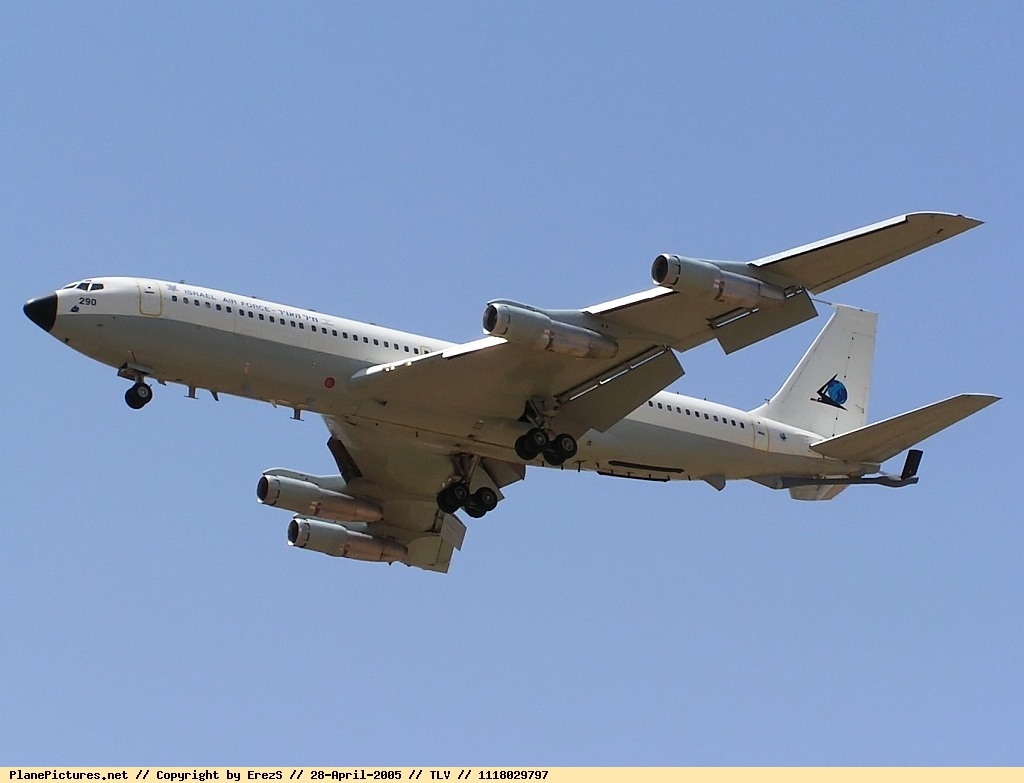
IAF KC-707. Courtesy planepictures.net
Question of the Day
In the name of freedom of expression, Americans are willing to endure this.
And tolerate this.
And put this on in prime-time.
So, why doesn't the MSM have the courage to publish or broadcast these cartoons?

Rampant political correctness = the death of free speech, both at home and abroad.
But, of course, something like this is perfectly acceptable.

Afterall, it's art.
Hat tip: Michelle Malkin
And tolerate this.
And put this on in prime-time.
So, why doesn't the MSM have the courage to publish or broadcast these cartoons?

Rampant political correctness = the death of free speech, both at home and abroad.
But, of course, something like this is perfectly acceptable.

Afterall, it's art.
Hat tip: Michelle Malkin
A Study in Contrasts
I was sitting in a hotel in downtown Washington, D.C. on Wednesday evening, flipping through the TV channels when I came across a remarkable made-for-cable film on the A&E network. Simply entitled "Flight 93," the film tells the story of the passengers and crew of the United Airlines flight that fought back against their hijackers on 9-11, forcing the jet to crash in a Pennsylvania field, killing all onboard. The heroism and sacrifice of Flight 93 saved the lives of hundreds, perhaps thousands of Americans on the ground. Before it crashed, Flight 93 was on a heading for Washington, with a likely target of the U.S. Capitol or the White House.
Based on a number of sources--including phone calls from passengers and crew to their family members on the ground--the film is a stirring depiction of the events on Flight 93, beginning with the routine boarding and depature from Newark. When the hijackers seize the aircraft (killing a passenger and the cockpit crew), the remaining passengers and crew members seem paralyzed, giving in to the natural human instinct to cooperate and hope for the best.
But, as they learn of the other events of 9-11 through phone calls to the ground, the heroes of Flight 93 decide to fight back, eventually storming the cockpit in a brave effort to retake the aircraft. As they push their way into the cockpit, the hijackers elect to fly the jet into the ground in rural Pennsylvania. The force of the impact and explosion were so great that rescue crews spent hours looking for the wreckage before realizing that virtually nothing was left of Flight 93.
Produced by TV veteran David Gerber and superbly directed by Peter Markle (Faith of My Fathers), the film brillantly depicts the spirit and courage of ordinary men and women who inspired a nation. And, perhaps most importantly, screen writer Nevin Schreiner tells the story without the moral relativism that typically affects Hollywood productions. We learn nothing about the hijackers, other than the fact that they are hell-bent on taking the jet and killing as many Americans as possible. Compared to Spielberg's Munich or the recent George Clooney vehicle, Syriana, Schreiner's honesty is nothing short of remarkable.
As Scott Johnson at Powerline notes, Flight 93 has already registered with viewers; the film's debut on A&E last Sunday was the most-watched program in the network's 20-year history, attracting nearly 6 million viewers (a huge audience by cable standards). By comparison, Munich and Syriana have fared poorly at the box office, although both films have received multiple Academy Award nominations.
When the Emmy nominations are announced later this spring, it will be interesting to see how Flight 93 fares. I'll go out on a limb and predict that the industry will ignore the film, because its message is out of synch with the rest of Hollywood.
Based on a number of sources--including phone calls from passengers and crew to their family members on the ground--the film is a stirring depiction of the events on Flight 93, beginning with the routine boarding and depature from Newark. When the hijackers seize the aircraft (killing a passenger and the cockpit crew), the remaining passengers and crew members seem paralyzed, giving in to the natural human instinct to cooperate and hope for the best.
But, as they learn of the other events of 9-11 through phone calls to the ground, the heroes of Flight 93 decide to fight back, eventually storming the cockpit in a brave effort to retake the aircraft. As they push their way into the cockpit, the hijackers elect to fly the jet into the ground in rural Pennsylvania. The force of the impact and explosion were so great that rescue crews spent hours looking for the wreckage before realizing that virtually nothing was left of Flight 93.
Produced by TV veteran David Gerber and superbly directed by Peter Markle (Faith of My Fathers), the film brillantly depicts the spirit and courage of ordinary men and women who inspired a nation. And, perhaps most importantly, screen writer Nevin Schreiner tells the story without the moral relativism that typically affects Hollywood productions. We learn nothing about the hijackers, other than the fact that they are hell-bent on taking the jet and killing as many Americans as possible. Compared to Spielberg's Munich or the recent George Clooney vehicle, Syriana, Schreiner's honesty is nothing short of remarkable.
As Scott Johnson at Powerline notes, Flight 93 has already registered with viewers; the film's debut on A&E last Sunday was the most-watched program in the network's 20-year history, attracting nearly 6 million viewers (a huge audience by cable standards). By comparison, Munich and Syriana have fared poorly at the box office, although both films have received multiple Academy Award nominations.
When the Emmy nominations are announced later this spring, it will be interesting to see how Flight 93 fares. I'll go out on a limb and predict that the industry will ignore the film, because its message is out of synch with the rest of Hollywood.
Wednesday, February 01, 2006
No Sense of Decency
Edward R. Murrow is often credited with turning public opinion against Senator Joseph McCarthy of Wisconsin with his famous See It Now broadcast in March 1954. In reality, the senator's downfall actually began a month later, during the famous Army-McCarthy hearings, televised nationally by ABC.
In the most famous exchange of the hearings (which lasted more than a month) McCarthy badgered Army counsel Joseph Welch about a young attorney in his Boston firm who belonged to the National Lawyer's Guild, an organization with alleged communist ties. Fed up with McCarthy's bullying, Welch finally asked, "Have you no sense of decency, sir, at long last have you left no sense of decency?"
After last night's "display" in the House Gallery, the same question might be posed to the moonbat left, and their chums in Congress. As you probably know, radical icon Cindy Sheehan was arrested in the gallery by Capitol Police shortly before President Bush's State of the Union Address, for wearing a T-shirt with an anti-war slogan. Sheehan was given a ticket for the event by California Congresswoman Lynn Woolsey, who said she was "proud" that Ms. Sheehan was her guest.
Personally, I'm proud that few people--and apparently, no TV cameras--showed up for an earlier Sheehan event, held outside the White House. And, judging from press coverage, last night's "bag a pot against Bush" appears to have been a bust as well. In Chicago, a couple of dozen protestors milled around Daley Plaza, according to Andrew Marcus. At least one moonbat was wearing "Abu Ghraib garb," despite temperatures in the 20s. With little public support, the anti-war left had to do something to re-energize its cause, so Cindy scored a seat in the House Gallery, thanks to her good friend Lynn Woolsey.
Free speech is one thing, but trying to turn the State of the Union address into a cheap protest stunt is something else. Could you imagine the outcry if a Republican member of Congress had invited Paula Jones or Kathleen Willey to attend one of Bill Clinton's State of the Union speeches? The outcry would have been deafening, with the MSM leading the charge.
Which brings us back to Mr. Welch and his question about simple, common decency on the stage of American democracy. Cindy Sheehan and her ilk abandoned any attempt at decency a long time ago, but Congresswoman Woolsey is another story. By helping orchestrate last night's stunt, Ms. Woolsey also surrendered any pretense of decorum and decency, and she needs to be held accountable. Censure is certainly in order, although Ms. Woolsey would probably wear that as a badge of honor.
If you think Ms. Woolsey should be censured for her stunt, let Speaker of the House Denny Hastert know. Here's the address/phone number for his office in D.C.:
235 Cannon HOB
Washington, DC 20515-1314
Phone: (202) 225-2976
And for those of you who'd like to give Ms. Woolsey an earful, here's how she can be reached:
2263 Rayburn HOB
Washington, DC 20515-0506
Phone: (202) 225-5161
Here's hoping that Ms. Woolsey gets a flood of angry phone calls and letters in the coming days. She deserves nothing less.
In the most famous exchange of the hearings (which lasted more than a month) McCarthy badgered Army counsel Joseph Welch about a young attorney in his Boston firm who belonged to the National Lawyer's Guild, an organization with alleged communist ties. Fed up with McCarthy's bullying, Welch finally asked, "Have you no sense of decency, sir, at long last have you left no sense of decency?"
After last night's "display" in the House Gallery, the same question might be posed to the moonbat left, and their chums in Congress. As you probably know, radical icon Cindy Sheehan was arrested in the gallery by Capitol Police shortly before President Bush's State of the Union Address, for wearing a T-shirt with an anti-war slogan. Sheehan was given a ticket for the event by California Congresswoman Lynn Woolsey, who said she was "proud" that Ms. Sheehan was her guest.
Personally, I'm proud that few people--and apparently, no TV cameras--showed up for an earlier Sheehan event, held outside the White House. And, judging from press coverage, last night's "bag a pot against Bush" appears to have been a bust as well. In Chicago, a couple of dozen protestors milled around Daley Plaza, according to Andrew Marcus. At least one moonbat was wearing "Abu Ghraib garb," despite temperatures in the 20s. With little public support, the anti-war left had to do something to re-energize its cause, so Cindy scored a seat in the House Gallery, thanks to her good friend Lynn Woolsey.
Free speech is one thing, but trying to turn the State of the Union address into a cheap protest stunt is something else. Could you imagine the outcry if a Republican member of Congress had invited Paula Jones or Kathleen Willey to attend one of Bill Clinton's State of the Union speeches? The outcry would have been deafening, with the MSM leading the charge.
Which brings us back to Mr. Welch and his question about simple, common decency on the stage of American democracy. Cindy Sheehan and her ilk abandoned any attempt at decency a long time ago, but Congresswoman Woolsey is another story. By helping orchestrate last night's stunt, Ms. Woolsey also surrendered any pretense of decorum and decency, and she needs to be held accountable. Censure is certainly in order, although Ms. Woolsey would probably wear that as a badge of honor.
If you think Ms. Woolsey should be censured for her stunt, let Speaker of the House Denny Hastert know. Here's the address/phone number for his office in D.C.:
235 Cannon HOB
Washington, DC 20515-1314
Phone: (202) 225-2976
And for those of you who'd like to give Ms. Woolsey an earful, here's how she can be reached:
2263 Rayburn HOB
Washington, DC 20515-0506
Phone: (202) 225-5161
Here's hoping that Ms. Woolsey gets a flood of angry phone calls and letters in the coming days. She deserves nothing less.
Tuesday, January 31, 2006
One Step Forward, One Step Back?
Representatives of the "Big Five" nuclear powers (U.S., Russia, China, Britain and France) have agreed to refer Iran's nuclear program to the UN Security Council. The announcement came after a marathon meeting in London that stretched into the early hours of Tuesday morning. Some observers expressed surprise at the decision; Moscow and Beijing had previously hinted that they might block the referral of Iran, which has extensive trade with both Russia and China.
Tehran's response was both angry and predictable, threatening to resume suspended nuclear activities. Iranian officials also said that the referral would mean the "end of diplomacy" over its nuclear program.
Good news, right? The west is finally acting with some degree of unity and decisiveness, setting the stage for sanctions against Iran and (potentially) military action.
Not so fast. Buried near the bottom of the AP story is this observation from Russia's foreign minister:
"In an apparent attempt to reassure Tehran, Russia underlined that referral to the Security Council will not mean immediate action."
"The Security Council will not make any decisions," Foreign Minister Sergey Lavrov said.
In other words, Russia is keeping its options open in the Security Council, including (possibly) the veto of measures or resolutions on Iran that Moscow considers too harsh. China could adopt a similar strategy, making it even more difficult for the UN to "punish" Iran (and I use that term advisedly).
Is Iran worried about the threat of UN action? Well, consider this headline, out of the OPEC meeting in Vienna. The Iranian representative has assured OPEC that his country will not curtail oil production, despite the UN referral. Obviously, Tehran can't afford the loss of revenue that would come with an embargo or decrease in production. But on the other hand, if Iran were truly concerned about UN sanctions, they would saying something completely different in Vienna, and actively play their oil card.
Make no mistake: referring Iran's nuclear program to the UN is a positive step. Now, the U.S. and its allies must avoid the mistake of taking a step backward, by letting Tehran's allies derail the process, or agreeing to some form of watered-down punishment.
Tehran's response was both angry and predictable, threatening to resume suspended nuclear activities. Iranian officials also said that the referral would mean the "end of diplomacy" over its nuclear program.
Good news, right? The west is finally acting with some degree of unity and decisiveness, setting the stage for sanctions against Iran and (potentially) military action.
Not so fast. Buried near the bottom of the AP story is this observation from Russia's foreign minister:
"In an apparent attempt to reassure Tehran, Russia underlined that referral to the Security Council will not mean immediate action."
"The Security Council will not make any decisions," Foreign Minister Sergey Lavrov said.
In other words, Russia is keeping its options open in the Security Council, including (possibly) the veto of measures or resolutions on Iran that Moscow considers too harsh. China could adopt a similar strategy, making it even more difficult for the UN to "punish" Iran (and I use that term advisedly).
Is Iran worried about the threat of UN action? Well, consider this headline, out of the OPEC meeting in Vienna. The Iranian representative has assured OPEC that his country will not curtail oil production, despite the UN referral. Obviously, Tehran can't afford the loss of revenue that would come with an embargo or decrease in production. But on the other hand, if Iran were truly concerned about UN sanctions, they would saying something completely different in Vienna, and actively play their oil card.
Make no mistake: referring Iran's nuclear program to the UN is a positive step. Now, the U.S. and its allies must avoid the mistake of taking a step backward, by letting Tehran's allies derail the process, or agreeing to some form of watered-down punishment.
Subscribe to:
Posts (Atom)